Retold in modern English
by Adrienne Potter
May be printed for classroom use
Copyright@2004 by Adrienne Potter
All rights reserved
No. of Visitors:
|
Retold in modern English by Adrienne Potter May be printed for classroom use Copyright@2004 by Adrienne Potter All rights reserved No. of Visitors: |
|
From the original "Horatius" by Thomas Babington Macaulay (1800-1859) originally published in 1842 (click to see original)
Kids were playing in the fields and summer air was blowing.
Mothers did their cooking as the afternoon was slowing.
The fathers of the city were all settled in a meeting,
While closer to this scene of peace a messenger was speeding.
Leaving dusty roads behind, the horse and he were sweating--
Riding on with urgent news the council would be dreading.
He rushed into the city as the kids and people scattered--
Until he reached the council chambers every second mattered.
The guardsmen saw him coming and they opened wide the doors.
He leaped down from his horse and hurried to the council floors.
Then every eye was on him and his words were full of pity:
"The army of Lars Porcena is headed towards the city!"
--"We'll sound the call to arms!" they said. "There isn't time!" he cried.
"For every city in his way that tried to fight has died!--
With twice five thousand men on horse and forty thousand walking--
They're gaining on us every moment as we stand here talking!"
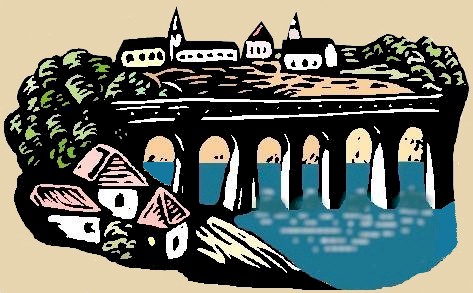
"The city is surrounded by the waters of the Tiber.
That mighty bridge across her must be cut at every fiber.
They will not cross the river as the rains have left it flooding.
Three warriors can guard the entrance way while we are cutting."
--"You speak the truth," the fathers said, "but which brave men will dare
To face the fifty thousand who will soon be swarming there?"
--"I will!" replied Horatius as he stood upon his feet.
"Ten battles have I finished and I've never seen defeat."
Spurius Lartius then jumped up and said, "Then I go too!
What better way to spend my final hours than with you?"
Then Herminius stepped forward saying, "I would lose my mind,
If you two went to battle and I had to stay behind."
Then every man was on his feet and messengers went flying.
Soon the city knew the reason for the trumpets crying.
Five hundred men were at the bridge beside the city fathers,
Destroying what took years to build to save their wives and daughters.
Dust clouds on the skyline now announced the grim arrival.
Every man worked faster now for this work meant survival.
The farmers from the valley and the peasants from the plains
Had taken refuge in the city with their flocks and grains.
Deserted was the countryside Lars Porcena would find,
Except for three men standing with a mighty bridge behind.
One hundred thousand warriors and fifty thousand steeds
Were marching to the city now with Porcena in the lead.
His eyes surveyed the scene ahead, the river and the bridge,
And then they stopped at those lone soldiers standing at the edge.
"What mighty joke do we have here?" he shouted out with laughter.
"So they've left three men here to guard the city that we're after!"
He sent his first three captains up to clear the bridge and cross,
But Spirius and Herminius made those three a loss.
"Well, well, we have some warriors," mocked Porcena to his crowd.
"Who dares to teach some manners to these men?" he shouted loud.
Three more men rode forward next and blood and dust went flying,
But when the air had settled the enemy lay dying.
"Let me show how I'll destroy them," cried his second in command,
And he rode towards Horatius with his sword and mace in hand.
The Roman moved like lightening with muscles of an ox,
The Tuscan had the strength of ten and wiles of a fox.
He flung the mace right at him but Horatius raised his shield,
And used his sword so fiercely that it made the Tuscan yield.
Then the Tuscan sword flashed and Horatius' thigh was bleeding.
He dropped his shield. A cheer went up! The Tuscan was defeating!
Horatius knew the danger but he leaped right at the foe,
And split his helmet clean in two, so heavy was the blow.
Horatius and his henchmen then faced them all in silence.
"Who dares now to cross the bridge?" He asked them in defiance.
The workmen and the fathers were now shouting from the wall,
"Come back! Come back, Horatius! See! The bridge is soon to fall!"
The timbers of the mighty bridge had now begun to crack,
Spurius and Herminius were quickly running back.
The bridge's heavy pillars were now trembling and shaking.
They gasped for breath and as they ran they felt the floor boards quaking.
And finally in a burst of speed they leaped towards the bank,
And turned to watch the splash of foam as giant pillars sank,
And it was in that moment that their hearts within them died,
As they saw lone Horatius standing on the other side.
So dizzy from the awful blows and weak from loss of blood--
In front of him the enemy; behind, a raging flood.
Throwing down his sword and shield and giving Porcena a nod,
He dove into the water whispering a prayer to God.
One hundred thousand Tuscan men and all the sons of Rome
Stand watching as the red-plumed helmet bobs amid the foam.
One more stroke and one more kick, but now he is gone under!
Seconds pass and will he rise again the fathers wonder?
The water rushes onward in an every growing roar
And then reveals the red-plumed helmet moving to the shore.
Now the water's at his chest and Spurius is running.
Herminius shouts through the waves, "Stay there now, we're coming!"
As they're wading to the bank the three of them are hearing
Romans here and Tuscans there combined in mighty cheering.
The mighty Roman warriors are borne into the fray.
Defeated by the Tiber floods, Lars Porcena rides away. The End.
HORATIUS (The original poem) by Thomas Babington Macaulay (1800-1859)
A LAY MADE ABOUT THE YEAR OF THE CITY CCCLX.
1 Lars Porsena
of Clusium
2 By the Nine
Gods he swore
3 That the great house of Tarquin
4 Should suffer wrong no more.
5 By the Nine Gods he swore it,
6 And named a
trysting day,
7 And bade his messengers ride forth,
8 East and west and south and north,
9 To summon his array.
2
10 East and west and south and north
11 The messengers ride fast,
12 And tower and town and cottage
13 Have heard the trumpet's blast.
14 Shame on the false Etruscan
15 Who lingers in his home,
16 When Porsena of Clusium
17 Is on the march for Rome.
3
18 The horsemen and the footmen
19 Are pouring in amain
20 From many a stately market-place;
21 From many a fruitful plain;
22 From many a lonely hamlet,
23 Which, hid by beech and pine,
24 Like an eagle's nest, hangs on the crest
25 Of purple Apennine;
4
26 From lordly Volaterræ,
27 Where scowls the far-famed hold
28 Piled by the hands of giants
29 For godlike kings of old;
30 From seagirt Populonia,
31 Whose sentinels descry
32 Sardinia's snowy mountain-tops
33 Fringing the southern sky;
5
34 From the proud mart of Pisæ,
35 Queen of the western waves,
36 Where ride Massilia's triremes
37 Heavy with fair-haired slaves;
38 From where sweet Clanis wanders
39 Through corn and vines and flowers;
40 From where Cortona lifts to heaven
41 Her diadem of towers.
6
42 Tall are the oaks whose acorns
43 Drop in dark Auser's
rill;
44 Fat are the stags that champ the boughs
45 Of the Ciminian hill;
46 Beyond all streams Clitumnus
47 Is to the herdsman dear,
48 Best of all pools the fowler loves
49 The great Volsinian
mere.
7
50 But now no stroke of woodman
51 Is heard by Auser's rill;
52 No hunter tracks the stag's green path
53 Up the Ciminian hill;
54 Unwatched along Clitumnus
55 Grazes the milk-white steer;
56 Unharmed the water fowl may dip
57 In the Volsinian mere.
8
58 The harvests of Arretium,
59 This year, old men shall reap;
60 This year, young boys in Umbro
61 Shall plunge the struggling sheep;
62 And in the vats of Luna,
63 This year, the must shall foam
64 Round the white feet of laughing girls,
65 Whose sires have marched to Rome.
9
66 There be thirty chosen prophets,
67 The wisest of the land,
68 Who alway by Lars Porsena
69 Both morn and evening stand:
70 Evening and morn the Thirty
71 Have turned the verses o'er,
72 Traced from the right on linen white
73 By mighty seers of yore.
10
74 And with one voice the Thirty
75 Have their glad answer given:
76 "Go forth, go forth, Lars Porsena;
77 Go forth, beloved of Heaven;
78 Go, and return in glory
79 To Clusium's royal dome;
80 And hang round Nurscia's altars
81 The golden shields of Rome."
11
82 And now hath every city
83 Sent up her tale of men;
84 The foot are fourscore thousand,
85 The horse are thousands ten.
86 Before the gates of Sutrium
87 Is met the great array.
88 A proud man was Lars Porsena
89 Upon the trysting day.
12
90 For all the Etruscan armies
91 Were ranged beneath his eye,
92 And many a banished Roman,
93 And many a stout ally;
94 And with a mighty following
95 To join the muster came
96 The Tusculan Mamilius,
97 Prince of the Latian
name.
13
98 But by the yellow Tiber
99 Was tumult and affright:
100 From all the spacious champaign
101 To Rome men took their flight.
102 A mile around the city,
103 The throng stopped up the ways;
104 A fearful sight it was to see
105 Through two long nights and days.
14
106 For aged folk on crutches,
107 And women great with child,
108 And mothers sobbing over babes
109 That clung to them and smiled,
110 And sick men borne in litters
111 High on the necks of slaves,
112 And troops of sun-burned husbandmen
113 With reaping-hooks and staves,
15
114 And droves of mules and asses
115 Laden with skins of wine,
116 And endless flocks of goats and sheep,
117 And endless herds of kine,
118 And endless trains of waggons
119 That creaked beneath the weight
120 Of corn-sacks and of household goods,
121 Choked every roaring gate.
16
122 Now, from the rock Tarpeian,
123 Could the wan
burghers spy
124 The line of blazing villages
125 Red in the midnight sky.
126 The Fathers of the City,
127 They sat all night and day,
128 For every hour some horseman came
129 With tidings of dismay.
17
130 To eastward and to westward
131 Have spread the Tuscan bands;
132 Nor house, nor fence, nor dovecote,
133 In Crustumerium
stands.
134 Verbenna down to Ostia
135 Hath wasted all the plain;
136 Astur hath stormed Janiculum,
137 And the stout guards are slain.
18
138 I wis, in all the Senate,
139 There was no heart so bold,
140 But sore it ached, and fast it beat,
141 When that ill news was told.
142 Forthwith up rose the Consul,
143 Up rose the Fathers all;
144 In haste they girded up their gowns,
145 And hied them to the wall.
19
146 They held a council standing,
147 Before the River-gate;
148 Short time was there, ye well may guess,
149 For musing or debate.
150 Out spake the Consul roundly:
151 "The bridge must straight go down;
152 For, since Janiculum is lost,
153 Nought else can save the town."
20
154 Just then a scout came flying,
155 All wild with haste and fear:
156 "To arms! to arms! Sir Consul;
157 Lars Porsena is here."
158 On the low hills to westward
159 The Consul fixed his eye,
160 And saw the swarthy storm of dust
161 Rise fast along the sky.
21
162 And nearer fast and nearer
163 Doth the red whirlwind come;
164 And louder still and still more loud,
165 From underneath that rolling cloud,
166 Is heard the trumpet's war-note proud,
167 The trampling, and the hum.
168 And plainly and more plainly
169 Now through the gloom appears,
170 Far to left and far to right,
171 In broken gleams of dark-blue light,
172 The long array of helmets bright,
173 The long array of spears.
22
174 And plainly and more plainly,
175 Above that glimmering line,
176 Now might ye see the banners
177 Of twelve fair cities shine;
178 But the banner of proud Clusium
179 Was highest of them all,
180 The terror of the Umbrian,
181 The terror of the
Gaul.
23
182 And plainly and more plainly
183 Now might the burghers know,
184 By port and vest, by horse and crest,
185 Each warlike Lucumo.
186 There Cilnius of Arretium
187 On his fleet roan was seen;
188 And Astur of the four-fold shield,
189 Girt with the brand none else may wield,
190 Tolumnius with the belt of gold,
191 And dark Verbenna from the hold
192 By reedy Thrasymene.
24
193 Fast by the royal standard,
194 O'erlooking all the war,
195 Lars Porsena of Clusium
196 Sat in his ivory car.
197 By the right wheel rode Mamilius,
198 Prince of the Latian name;
199 And by the left false Sextus,
200 That wrought the deed of shame.
25
201 But when the face of Sextus
202 Was seen among the foes,
203 A yell that rent the firmament
204 From all the town arose.
205 On the house-tops was no woman
206 But spat towards him and hissed;
207 No child but screamed out curses,
208 And shook its little flst.
26
209 But the Consul's brow was sad,
210 And the Consul's speech was low,
211 And darkly looked he at the wall,
212 And darkly at the foe.
213 "Their van will be upon us
214 Before the bridge goes down;
215 And if they once may win the bridge,
216 What hope to save the town?"
27
217 Then out spake brave Horatius,
218 The Captain of the gate:
219 "To every man upon this earth
220 Death cometh soon or late.
221 And how can man die better
222 Than facing fearful odds,
223 For the ashes of his fathers,
224 And the temples of his Gods,
28
225 "And for the tender mother
226 Who dandled him to rest,
227 And for the wife who nurses
228 His baby at her breast,
229 And for the holy maidens
230 Who feed the eternal flame,
231 To save them from false Sextus
232 That wrought the deed of shame?
29
233 "Hew down the bridge, Sir Consul,
234 With all the speed ye may;
235 I, with two more to help me,
236 Will hold the foe in play.
237 In yon strait path a thousand
238 May well be stopped by three.
239 Now who will stand on either hand,
240 And keep the bridge with me?"
30
241 Then out spake Spurius Lartius;
242 A Ramnian proud was
he:
243 "Lo, I will stand at thy right hand,
244 And keep the bridge with thee."
245 And out spake strong Herminius;
246 Of Titian blood was
he:
247 "I will abide on thy left side,
248 And keep the bridge with thee."
31
249 "Horatius," quoth the Consul,
250 "As thou sayest, so let it
be."
251 And straight against that great array
252 Forth went the dauntless Three.
253 For Romans in Rome's quarrel
254 Spared neither land nor gold,
255 Nor son nor wife, nor limb nor life,
256 In the brave days of old.
32
257 Then none was for a party;
258 Then all were for the state;
259 Then the great man helped the poor,
260 And the poor man loved the great:
261 Then lands were fairly portioned;
262 Then spoils were fairly sold:
263 The Romans were like brothers
264 In the brave days of old.
33
265 Now Roman is to Roman
266 More hateful than a foe,
267 And the Tribunes beard the high,
268 And the Fathers grind the low.
269 As we wax hot in faction,
270 In battle we wax cold:
271 Wherefore men fight not as they fought
272 In the brave days of old.
34
273 Now while the Three were tightening
274 Their harness on their backs,
275 The Consul was the foremost man
276 To take in hand an axe:
277 And Fathers mixed with Commons
278 Seized hatchet, bar, and crow,
279 And smote upon the planks above,
280 And loosed the props below.
35
281 Meanwhile the Tuscan army,
282 Right glorious to behold,
283 Came flashing back the noonday light,
284 Rank behind rank, like surges bright
285 Of a broad sea of gold.
286 Four hundred trumpets sounded
287 A peal of warlike glee,
288 As that great host, with measured tread,
289 And spears advanced, and ensigns spread,
290 Rolled slowly towards the bridge's head,
291 Where stood the dauntless Three.
36
292 The Three stood calm and silent
293 And looked upon the foes,
294 And a great shout of laughter
295 From all the vanguard rose:
296 And forth three chiefs came spurring
297 Before that mighty
mass;
298 To earth they sprang, their swords they drew,
299 And lifted high their shields, and flew
300 To win the narrow
pass;
37
301 Aunus from green Tifernum,
302 Lord of the Hill of Vines;
303 And Seius, whose eight hundred slaves
304 Sicken in Ilva's
mines;
305 And Picus, long to Clusium
306 Vassal in peace and war,
307 Who led to fight his Umbrian powers
308 From that grey crag where, girt with towers,
309 The fortress of Nequinum towers
310 O'er the pale waves
of Nar.
38
311 Stout Lartius hurled down Aunus
312 Into the stream beneath:
313 Herminius struck at Seius,
314 And clove him to the teeth:
315 At Picus brave Horatius
316 Darted one fiery thrust;
317 And the proud Umbrian's gilded arms
318 Clashed in the bloody dust.
39
319 Then Ocnus of Falerii
320 Rushed on the Roman Three;
321 And Lausulus of Urgo,
322 The rover of the sea;
323 And Aruns of Volsinium,
324 Who slew the great wild boar,
325 The great wild boar that had his den
326 Amidst the reeds of Cosa's fen,
327 And wasted fields, and slaughtered men,
328 Along Albinia's shore.
40
329 Herminius smote down Aruns:
330 Lartius laid Ocnus low:
331 Right to the heart of Lausulus
332 Horatius sent a blow.
333 "Lie there," he cried, "fell pirate!
334 No more, aghast and pale,
335 From Ostia's walls the crowd shall mark
336 The track of thy destroying bark.
337 No more Campania's hinds shall fly
338 To woods and caverns when they spy
339 Thy thrice accursed sail."
41
340 But now no sound of laughter
341 Was heard amongst the foes.
342 A wild and wrathful clamour
343 From all the vanguard rose.
344 Six spears' lengths from the entrance
345 Halted that mighty
mass,
deep array 346 And for a space no man came forth
347 To win the narrow
pass.
way 42
348 But hark! the cry is Astur:
349 And lo! the ranks divide;
350 And the great Lord of Luna
351 Comes with his stately stride.
352 Upon his ample shoulders
353 Clangs loud the four-fold shield,
354 And in his hand he shakes the brand
355 Which none but he can wield.
43
356 He smiled on those bold Romans
357 A smile serene and high;
358 He eyed the flinching Tuscans,
359 And scorn was in his eye.
360 Quoth he, "The she-wolf's litter
361 Stand savagely at bay:
362 But will ye dare to follow,
363 If Astur clears the way?"
44
364 Then, whirling up his broadsword
365 With both hands to the height,
366 He rushed against Horatius,
367 And smote with all his might.
368 With shield and blade Horatius
369 Right deftly turned the blow.
370 The blow, though turned, came yet too nigh;
371 It missed his helm, but gashed his thigh:
372 The Tuscans raised a joyful cry
373 To see the red blood flow.
45
374 He reeled, and on Herminius
375 He leaned one breathing-space;
376 Then, like a wild cat mad with wounds,
377 Sprang right at Astur's face.
378 Through teeth, and skull, and helmet,
379 So fierce a thrust he sped,
380 The good sword stood a hand-breadth out
381 Behind the Tuscan's head.
46
382 And the great Lord of Luna
383 Fell at that deadly stroke,
384 As falls on Mount Alvernus
385 A thunder-smitten oak.
386 Far o'er the crashing forest
387 The giant arms lie spread;
388 And the pale augurs, muttering low,
389 Gaze on the blasted head.
47
390 On Astur's throat Horatius
391 Right firmly pressed his heel,
392 And thrice and four times tugged amain,
393 Ere he wrenched out the steel.
394 "And see," he cried, "the welcome,
395 Fair guests, that waits you here!
396 What noble Lucumo comes next
397 To taste our Roman cheer?"
48
398 But at his haughty challenge
399 A sullen murmur ran,
400 Mingled of wrath, and shame, and dread,
401 Along that
glittering van.
402 There lacked not men of prowess,
403 Nor men of lordly race;
404 For all Etruria's noblest
405 Were round the fatal place.
49
406 But all Etruria's noblest
407 Felt their hearts sink to see
408 On the earth the bloody corpses,
409 In the path the dauntless Three:
410 And, from the ghastly entrance
411 Where those bold Romans stood,
412 All shrank, like boys who unaware,
413 Ranging the woods to start a hare,
414 Come to the mouth of the dark lair
415 Where, growling low, a fierce old bear
416 Lies amidst bones and blood.
50
417 Was none who would be foremost
418 To lead such dire attack:
419 But those behind cried "Forward!"
420 And those before cried "Back!"
421 And backward now and forward
422 Wavers the deep array;
423 And on the tossing sea of steel,
424 To and fro the standards reel;
425 And the victorious trumpet-peal
426 Dies fitfully away.
51
427 Yet one man for one moment
428 Strode out before the crowd;
429 Well known was he to all the Three,
430 And they gave him greeting loud.
431 "Now welcome, welcome, Sextus!
432 Now welcome to thy home!
433 Why dost thou stay, and turn away?
434 Here lies the road to Rome."
52
435 Thrice looked he at the city;
436 Thrice looked he at the dead;
437 And thrice came on in fury,
438 And thrice turned back in dread:
439 And, white with fear and hatred,
440 Scowled at the narrow way
441 Where, wallowing in a pool of blood,
442 The bravest Tuscans lay.
53
443 But meanwhile axe and lever
444 Have manfully been plied;
445 And now the bridge hangs tottering
446 Above the boiling tide.
447 "Come back, come back, Horatius!"
448 Loud cried the Fathers all.
449 "Back, Lartius! back, Herminius!
450 Back, ere the ruin fall!"
54
451 Back darted Spurius Lartius;
452 Herminius darted back:
453 And, as they passed, beneath their feet
454 They felt the timbers crack.
455 But when they turned their faces,
456 And on the farther shore
457 Saw brave Horatius stand alone,
458 They would have crossed once more.
55
459 But with a crash like thunder
460 Fell every loosened beam,
461 And, like a dam, the mighty wreck
462 Lay right athwart the stream:
463 And a long shout of triumph
464 Rose from the walls of Rome,
465 As to the highest turret-tops
466 Was splashed the yellow foam.
56
467 And, like a horse unbroken
468 When first he feels the rein,
469 The furious river struggled hard,
470 And tossed his tawny mane;
471 And burst the curb and bounded,
472 Rejoicing to be free;
473 And whirling down, in fierce career,
474 Battlement, and plank, and pier,
475 Rushed headlong to the sea.
57
476 Alone stood brave Horatius,
477 But constant still in mind;
478 Thrice thirty thousand foes before,
479 And the broad flood behind.
480 "Down with him!" cried false Sextus,
481 With a smile on his pale face.
482 "Now yield thee," cried Lars Porsena,
483 "Now yield thee to our grace."
58
484 Round turned he, as not deigning
485 Those craven ranks to see;
486 Nought spake he to Lars Porsena,
487 To Sextus nought spake he;
488 But he saw on Palatinus
489 The white porch of his home;
490 And he spake to the noble river
491 That rolls by the towers of Rome.
59
492 "Oh, Tiber! father Tiber!
493 To whom the Romans pray,
494 A Roman's life, a Roman's arms,
495 Take thou in charge this day!"
496 So he spake, and speaking sheathed
497 The good sword by his side,
498 And, with his harness on his back,
499 Plunged headlong in the tide.
60
500 No sound of joy or sorrow
501 Was heard from either bank;
502 But friends and foes in dumb surprise,
503 With parted lips and straining eyes,
504 Stood gazing where he sank;
505 And when above the surges
506 They saw his crest appear,
507 All Rome sent forth a rapturous cry,
508 And even the ranks of Tuscany
509 Could scarce forbear to cheer.
61
510 But fiercely ran the current,
511 Swollen high by months of rain:
512 And fast his blood was flowing;
513 And he was sore in pain,
514 And heavy with his armour,
515 And spent with changing blows:
516 And oft they thought him sinking,
517 But still again he rose.
62
518 Never, I ween, did swimmer,
519 In such an evil case,
520 Struggle through such a raging flood
521 Safe to the landing place:
522 But his limbs were borne up bravely
523 By the brave heart within,
524 And our good father Tiber
525 Bare bravely up his
chin.
63
526 "Curse on him!" quoth false Sextus;
527 "Will not the villain drown?
528 But for this stay, ere close of day
529 We should have sacked the town!"
530 "Heaven help him!" quoth Lars Porsena,
531 "And bring him safe to shore;
532 For such a gallant feat of arms
533 Was never seen before."
64
534 And now he feels the bottom;
535 Now on dry earth he stands;
536 Now round him throng the Fathers
537 To press his gory hands;
538 And now with shouts and clapping,
539 And noise of weeping loud,
540 He enters through the River-gate,
541 Borne by the joyous crowd.
65
542 They gave him of the corn-land,
543 That was of public right,
544 As much as two strong oxen
545 Could plough from morn till night;
546 And they made a molten image,
547 And set it up on high,
548 And there it stands unto this day
549 To witness if I lie.
66
550 It stands in the Comitium,
551 Plain for all folk to see;
552 Horatius in his harness,
553 Halting upon one knee:
554 And underneath is written,
555 In letters all of gold,
556 How valiantly he kept the bridge
557 In the brave days of old.
67
558 And still his name sounds stirring
559 Unto the men of Rome,
560 As the trumpet-blast that cries to them
561 To charge the Volscian home;
562 And wives still pray to Juno
563 For boys with hearts as bold
564 As his who kept the bridge so well
565 In the brave days of old.
68
566 And in the nights of winter,
567 When the cold north winds blow,
568 And the long howling of the wolves
569 Is heard amidst the snow;
570 When round the lonely cottage
571 Roars loud the tempest's din,
572 And the good logs of Algidus
573 Roar louder yet within;
69
574 When the oldest cask is opened,
575 And the largest lamp is lit,
576 When the chesnuts glow in the embers,
577 And the kid turns on the spit;
578 When young and old in circle
579 Around the firebrands close;
580 When the girls are weaving baskets,
581 And the lads are shaping bows;
70
582 When the goodman mends his armour,
583 And trims his helmet's plume;
584 When the goodwife's shuttle merrily
585 Goes flashing through the loom;
586 With weeping and with laughter
587 Still is the story told,
588 How well Horatius kept the bridge
589 In the brave days of old.
Explanation of Names and Places:
Line No. /Name
"Our ladye bare upp her chinne."
Ballad of Childe Waters.
"Never heavier man and horse
Stemmed a midnight torrent's force;
* * * * *
Yet, through good heart and our Lady's grace,
At length he gained the landing place."
Lay of the Last Minstrel, I.
Thomas Macaulay's source of information:
"IX. Next Publius Valerius (for the second time) and Titus Lucretius were made consuls. By this time the Tarquinii had sought refuge with Lars Porsinna, king of Clusium. There they mingled advice and entreaty, now imploring him not to permit them, Etruseans by birth and of the same blood and the same name as himself, to suffer the privations of exile, and again even warning him not to allow the growing custom of expelling kings to go unpunished. Liberty was sweet enough in itself. Unless the energy with which nations sought to obtain it were matched by the efforts which kings put forth to defend their power, the highest would be reduced to the level of the lowest; there would be nothing lofty, nothing that stood out above the rest of the state; there was the end of monarchy, the noblest institution known to gods or men. Porsinna, believing that it was not only a safe thing for the Etruscans that there should be a king at Rome, but an Honour to have that king of Etruscan stock, invaded Roman territory with a hostile army. Never before had such fear seized the senate, so powerful was Clusium in those days, and so great Porsinna's fame. And they feared not only the enemy but their own citizens, lest the plebs should be terror-stricken and, admitting the princes into the City, should even submit to enslavement, for the sake of peace. Hence the senate at this time granted many favours to the plebs. The question of subsistence received special attention, and some were sent to the Volsci and others to Cumae to buy up corn. Again, the monopoly of salt, the price of which was very high, was taken out of the hands of individuals and wholly assumed by the government. Imposts and taxes were removed from the plebs that they might be borne by the well-to-do, who were equal to the burden: the poor paid dues enough if they reared children. Thanks to this liberality on the part of the Fathers, the distress which attended the subsequent blockade and famine was powerless to destroy the harmony of the state, which was such that the name of king was not more abhorrent to the highest than to the lowest; nor was there ever a man in after years whose demagogic arts made him so popular as its wise governing at that time made the whole senate."X. When the enemy appeared, the Romans all, with one accord, withdrew from their fields into the City, which they surrounded with guards. Some parts appeared to be rendered safe by their walls, others by the barrier formed by the river Tiber. The bridge of piles almost afforded an entrance to the enemy, had it not been for one man, Horatius Cocles; he was the bulwark of defence on which that day depended the fortune of the City of Rome. He chanced to be on guard at the bridge when Janiculum was captured by a sudden attack of the enemy. He saw them as they charged down on the run from Janiculum, while his own people behaved like a frightened mob, throwing away their arms and quitting their ranks. Catching hold first of one and then of another, blocking their way and conjuring them to listen, he called on gods and men to witness that if they forsook their post it was vain to flee; once they had left a passage in their rear by the bridge, there would soon be more of the enemy on the Palatine and the Capitol than on Janiculum. He therefore warned and commanded them to break down the bridge with steel, with fire, with any instrument at their disposal; and promised that he would himself receive the onset of the enemy, so far as it could be withstood by a single body. Then, striding to the head of the bridge, conspicuous amongst the fugitives who were clearly seen to be shirking the fight, he covered himself with his sword and buckler and made ready to do battle at close quarters, confounding the Etruscans with amazement at his audacity. Yet were there two who were prevented by shame from leaving him. These were Spurius Larcius and Titus Herminius, both famous for their birth and their deeds. With these he endured the peril of the first rush and the stormiest moment of the battle. But after a while he forced even these two to leave him and save themselves, for there was scarcely anything left of the bridge, and those who were cutting it down called to them to come back. Then, darting glances of defiance around at the Etruscan nobles, he now challenged them in turn to fight, now railed at them collectively as slaves of haughty kings, who, heedless of their own liberty, were come to overthrow the liberty of others. They hesitated for a moment, each looking to his neigbbour to begin the fight. Then shame made them attack, and with a shout they cast their javelins from every side against their solitary foe. But he caught them all upon his shield, and, resolute as ever, bestrode the bridge and held his ground; and now they were trying to dislodge him by a charge, when the crash of the falling bridge and the cheer which burst from the throats of the Romans, exulting in the completion of their task, checked them in mid-career with a sudden dismay. Then Cocles cried, "O Father Tiberinus, I solemnly invoke thee; receive these arms and this soldier with propitious stream!" So praying, all armed as he was, he leaped down into the river, and under a shower of missiles swam across unhurt to his fellows, having given a proof of valour which was destined to obtain more fame than credence with posterity. The state was grateful for so brave a deed: a statue of Cocles was set up in the comitium, and he was given as much land as he could plough around in one day. Private citizens showed their gratitude in a striking fashion, in the midst of his official honours, for notwithstanding their great distress everybody made him some gift proportionate to his means, though he robbed himself of his own ration" (Livy, I, translated by B. O. Foster [Cambridge: Harvard University Press, 1967]: 245-49; PA 6452 A2 Robarts Library).
Return to Kids Korner Story Index