Accident on the River: A real-life adventure story
by Adrienne Potter
|
Accident on the River: A real-life adventure story by Adrienne Potter
|
|
I remember having a strange foreboding as I drove through Northeastern Utah to the meeting place for the river trip. I thought about canceling, but I had already committed to serving as the chef and if I didn't follow through there would be no one to take my place. It was probably my fifteenth trip down Lodore Canyon of the Green River in Dinosaur National Monument. I was 24 years old and had completed dozens of other trips on the Yampa, the Colorado, and other sections of the Green River and had even obtained my boatmen’s license while working as a chef for the river trip company. Later on I became their Office Manager, filling in as a boatman or trip director when there was a need.
During the long drive I thought back to my first river trip when John, the trip director had stopped the entire caravan at a sand bar and instructed the boatmen to carry buckets of water to the middle of it and pour them on it. It quickly became a giant mud hole and we were instructed to kneel around it in a circle for a ceremony to Yogi, the River God. We did exactly as we were told. He raised his arms high in the air and told us to copy him. We did. He said "Repeat after me," and cried out, "Oh Yogi! Watanah! Siam!" We repeated it. He flopped face down in the mud. We did the same. He rose up and did it again, saying it faster this time. "Oh Yogi! Watanah! Siam!" We copied him into the mud, laughing at ourselves. The boatmen were laughing the hardest because they already knew what we were saying. By the third time we had all caught on and a giant mud fight began, with flips, belly-flops, and somersaults in the mud, as well as a lot of mud-slinging. Afterwards we all rinsed off in the river and experienced the exhilaration of being clean again.
Today we were starting just
South of Flaming Gorge Reservoir, a few hours and a few miles above Hell’s
Half Mile, a section of rapids named by Colonel John Wesley Powell when he first
traversed this area in 1869. At
the start of the rapids was a particularly bad one he named Hell’s Hole (and
rightfully so!) after
one of his boats was destroyed where the river current took it directly over a
large boulder and down into a hole on the other side.
This was followed by a half-mile of heavy rapids surrounded by canyon
walls several thousand feet high. This
section could be very rough and dangerous in high water and as gentle as a
bathtub later on in the summer when the water was lower.
It was spring, the
time seasoned river runners like best because the rapids are the most
challenging. Flaming Gorge
Reservoir had received record runoff in the early spring from heavy snows that
winter, and unbeknownst to us, the dam Hydraulic Engineers were forced to open
the dam floodgates wider than they had ever been. This was our first trip of the year on this river and the
water seemed a little higher than the previous spring since the watermarks were
underwater, but we weren’t overly concerned.
The first few trips were always the most challenging and we were looking
forward to a great adventure.
After two hours of peaceful floating and sighting deer on the
tree-covered slopes, the group, consisting of eight six-man rafts, rowed to the
bank just before Hell’s Half Mile to scout the rapids.
The boats were pulled high up on the sand and everyone took a short hike.
From a rocky vantage point about a hundred feet above the rapids we could
see the white water churn and broil as it tumbled over huge boulders that had
been there thousands of years.
The boatmen had been in
other tight spots before and humor helped them cope with it, but now Carl and the boatmen were starting to get
worried. There was no turning back.
Once you start down Lodore Canyon you have to keep on going because there
are no passes to hike out of the steep gorges until you reach the confluence of
the Green and Yampa Rivers, a half-day’s journey downriver.
It was evident now that the water was at its highest level in history.
At normal water conditions these rapids were rated Class III on a scale of
one to six, but today Hell's Half Mile was Class IV, and Hell's Hole was Class
V. There were no water marks on the trees, the rocks, or the canyon walls;
the river was wider, and the tremendous amount of water being let out of the dam
was being forced through the narrow canyon with huge pressure.
Should we portage (hike
across land while towing the boats on long ropes) or should we take our chances?
The group voted to tough it out on the water because portaging could
damage the boats and the gear in these water conditions.
We returned to our boats, checked the packs to make sure they were
secure, and everyone put their mandatory life jackets back on.
I was so busy checking the lunches that were my responsibility that I
forgot to check my own life jacket (check IQ), which had become untied at the top.
I sat in the back of the boat, the most precarious spot, because I was
the most experienced river rat on the boat besides the boatman, Carl.
We started downriver and though Carl was the guide we were third in line because the first boatman thought he saw a way to make it through Hell’s Hole. The others would follow him like sheep off a cliff. The first boat made it safely through, barely skirting around the edge of the huge hole while we waited in calm waters. They waved to the second boat which started downriver and we watched as they screamed in fear and delight while paddling vigorously through the churning water. The boatman tried so hard to stay away from the boulder that one of his oars hit the rocky river wall and smashed in two. As they quickly switched to the spare oar one of his crew moved the broken pieces up and down in the air caveman fashion, as a victory sign. They signaled for us to follow and we started out.
Our boat was the heaviest since Carl was the tallest and strongest boatman--it
held the chef’s kit with its iron pots and steel stoves.
"Thanks a lot," he had told his fellow boatmen with a salute as they
elected him to this duty. Now the moment we had been anticipating all
morning was here. We were rocking and rolling through the massive water towards Hell’s Hole!
Carl was rowing deeply and steadily with the oars but the boat wasn’t responding as it should. The high, heavy pack had shifted left in the powerful, rolling waves and now we were moving directly toward the huge boulder instead of skirting around it as the other boats had. The weight of the pack caused us to sit lower in the water and so we took on more water with each wave, making us even heavier.
We were all bailing water when Carl barked the order to paddle on the left and everyone on the left side, glancing at his straining muscles and anxious expression, dug into the water with all their might. He ordered the right side to back paddle and since I was in the back I did both, paddling forward on one side and then quickly switching to the other side and paddling backward as I had been trained. "Okay! Everyone into the water for our afternoon swim!" he cracked through teeth clenched with effort.
With all of our efforts the boat was still not responding.
The water had risen even higher since our hike because it had started
raining heavily upriver. The
current was like a huge vacuum, suctioning us towards the gigantic boulder and
Hell’s Hole. We struggled even harder, digging our paddles downward and
pulling them back hard.
The split-second
realization came to Carl that the was battle was lost and suddenly he cried,
“Hold on! We’re going over!”
He
continued manning the oars in an effort to steer the boat straight and prevent
a capsize even as we shot over the boulder, but everyone else dropped their
paddles and grabbed ropes, oar loops, the boat frame, and anything that was
firmly attached to the twenty-foot rubber raft.
Carl locked his feet under the pontoons to steady himself as we went
over. I had a sudden inspiration to
grab the end of one of the two-inch by five-foot canvass straps that was
attached to the back of the boat frame, and quickly wrapped it several times around my
right hand. It was wet from the
half foot of water that the waves had poured into the boat and it stuck to my
hand like Velcro.
Suddenly I felt the
boat go out from under me as it dove over the boulder nose-down.
The momentum slapped me way up into the air like a
pizza, but my strap
acted like a whip and jerked me back down again and I felt my back smack
against the solid wooden boat frame with a thud.
I fell to the bottom of the boat still holding the canvass strap and lay
there in the water as we bounced through the remainder of Hell’s Half Mile.
I tried to get up but couldn’t and cold water splashed over me and made
me shiver. It was then that I
noticed my life jacket wasn’t tied and I was suddenly thankful that I had
latched on to the canvas strap. Without
it I would have been thrown right out of the boat, and my life jacket, which was
too big for me because we had run out of my size, probably would have
come off in the heavy current. People
had died in these waters without life jackets.
|
|
"What rock?" |
It seemed like an
eternity until we reached shore, but soon the group was docked so the boatmen
could check for damage. I tried to
stand and immediately fell back down. “Are
you alright?” Carl asked from above with a concerned tone.
I turned my head and looked up at him.
“I don’t know,” I gasped. “I
hit my back on the boat frame and I feel really weak.”
He deadpanned, "You've fallen and you can't get up." He helped me stand up and supported me as I walked along the pontoon to
the front of the boat. I nearly
fell off the boat and he grabbed for me.
"What's really in that water bottle?" he teased. Once
on the soft sand I began to pass out and he and a fellow passenger slowed my
fall. The rain had caught up
with us and began to drop everywhere. I lay in the wet sand feeling dizzy
and nauseous, the first stages of shock.
A boatman named Fred came
over and said with a sarcastic smile, "That was a smooth trip Carl."
Carl said, "Thanks, I'll show you how I did it next time." He
and the other boatmen became instant medics as they bent over me, asking me where
it hurt. "She's dead,
Jim," said Carl, knowing I was a Star Trek fan. They rolled me on my
side and inspected my lower back above my swimsuit bottoms. It was bruised and swollen. "Guess
you'll have to operate," I said through my shivering teeth. They helped me try to stand again and the pain
became unbearable, so it was decided we would set up camp right here.
"I'll look for a Motel 6," said Fred with a smile. This
area was not certified as a campground by the Forest Service but since this was an emergency it
would have to do. There were no
outhouses so we would have to bury our waste according to Federal Law in the
1970’s. We were deep inside
Dinosaur National Monument. There
were no phones, no roads, no cabins, no caves,
no firepits. My only hope was a
ranger station four hours downstream
through heavy rapids, and we couldn't do it in the rain.
I was covered with
jackets and friends held a tarp over me until the boats could be unloaded and the packs and tents
retrieved. Carl and Fred promptly set up a tent and installed my sleeping bag inside it, and
four boatmen carried me inside as carefully as possible.
"Okay, so its not the Hilton," said Fred. I had become feverish and delirious and they were afraid my back was
broken. Teryl Hinds, a friend from
High School and a nursing student, had agreed to stay in the tent with me.
"Now don't you dare throw up," she said with mock severity.
I was unaware of time passing as Teryl’s twin, Cheryl passed dinner
through the tent flap, which I made a valiant but unsuccessful effort to eat
(the dinner, not the tent flap). Teryl
watched over me throughout the night and gave me water and pain pills on
schedule. She slept too but my
groans awoke her regularly. "You're
such a baby," she said, but didn't mean it. I
couldn’t stay asleep or awake, and I couldn’t find a position that wasn’t painful.
Finally dawn came and Carl and Fred gently helped me into a private field and left me to relieve myself since we had no bedpans or other medical equipment other than emergency first aid gear. "We aren't doing any more for you after this," said Carl with a twinkle in his eye. After awhile I yelled to them and they returned to help me back to camp and my sleeping bag. Carl got the trip menu out of my backpack and breakfast was prepared without me, the chef, and they did a rather good job of it in spite of my absence, though Skip was joshing Fred about using river water to make the OJ. The tent was disassembled around me and all the gear was packed except mine.
Carl carefully set up the boat pack so that it was flat on top, using
packs for cushions. They gently
carried me and laid me on top of the pack, though my feet hung over one side.
Carl placed my hands under the pack ropes and told me to hold on, and
moved my feet under some tight ropes that I could use to keep myself centered
when we hit rough water, which would come almost immediately.
Last of all, my
sleeping bag was packed into my duffle bag and added to Fred's boat pack where
the crew had been waiting patiently for it.
"Do you think you'll need this?" Fred yelled over to me with his
quirky smile. We started down river and instantly I felt more pain as the boat jolted
and jerked in the current. I cried
and groaned as Carl sympathetically held the boat in calmer waters and out of
the rapids whenever possible, but there were places where we had no choice but
to roller coaster through the rough water.
I used my legs and arm muscles to steady myself against the movement to
avoid further injury.
In
the calm stretches I slept, and finally we arrived at the confluence of the two
rivers where the Ranger Station stood. The
riverbank was eight feet high here ("Where's the elevator?" said Carl)
and so they had no choice but to carry me
carefully and with great difficulty up a sandy opening in the bank, across a
large field, and into the Ranger’s cabin.
The ranger radioed
Forest Service Headquarters, twenty miles away.
They consulted with the nearest hospital for advice.
The problem was that the only way out of the canyon at this point was
twelve, steep, curving miles of very rocky and bumpy dirt road--a two-hour
journey, and after my precarious but unavoidable river ride they didn’t want
to risk it, though Skip teased me about wimping out. As it happened, there
was a forest fire near Flaming Gorge caused by lightening from the rainstorm the
previous day and a number of helicopters had been dispatched to fight it.
One was refueling in Vernal, near the hospital.
The pilot agreed to come and get me.
After another hour we
heard the roar of the rotors and saw them whipping the tree branches in the wind
as the chopper landed in the field near the ranger station.
I was strapped securely to a backboard and carried to the helicopter,
which held the pilot, a nurse, and a Forest Service Supervisor.
It was not a large
helicopter and they had to put me in sideways, with my head sticking out one
door and my feet protruding out the other.
I was fully supported underneath by the six-foot board, so it didn’t
matter. All
the boatmen, my
friends, and the rest of the gang wished me well and as the helicopter took off Fred called out, "Oh! Did you need to use the restroom?"
Headwinds!
The confluence of the Green and Yampa Rivers is where three canyons, each
two thousand feet deep, converge. This
means that winds from the storm we had left behind and natural canyon breezes
coming from three directions, would meet and force each other up or down.
We were forced down. The
pilot tried going a different direction.
Downdrafts! We rose a
thousand feet but again we were forced back down.
After they discussed descending and leaving someone behind he dismissed
that option and turned us towards the third canyon.
I heard the motors roaring as he gave it full power. We rose slowly, slowly, and when I turned me head I could see
bird nests on the canyon wall.
We kept rising, then
falling, then rising again, and I was being ignored as everyone focused on the
pilot’s efforts. They were all
tense and as I turned my head and looked downward hundreds of feet to the ribbon
of river water below the helicopter jolted wildly as it hit another downdraft.
I screamed in fear and pain, thinking we were falling, but moments later
we cleared the top of the cliff and I could see dirt, sage, and rabbit pellets
five feet below my head on the ground at the top of the cliff.
The nurse, hearing my scream above the roar of the engine, had scrambled
to attend me. “Sorry,” I said
as I realized that three people had just risked their lives to fly me out of the
canyon.
Within a half hour we
had landed at the small airport in Vernal, Utah, and an ambulance was waiting to
take me to the hospital. In the
ambulance a nurse took my pulse, blood pressure, and set up an IV.
In the hospital my back was thoroughly ex-rayed, but the only thing
broken was my tailbone. Unfortunately, ligaments and tendons along my spine had been
damaged that would prevent me from walking or sitting without pain for six
months, and would give me bouts of soreness for the rest of my life.
I was in the hospital
for the fourth of July and could see fireworks from my window.
The rest of the group had continued downriver and had a great time
without me, but they came to visit me at the hospital before returning to Salt
Lake City. "We had a lot of fun after
you left," they teased. "Gee I missed you guys," I
retorted. I was kept there for
about a week and then my mother brought the family station wagon up to carry me
home. They had made a bed for me in
the back of it and another bed for me downstairs in the family room, where I
stayed for two weeks. The next
month I signed up for another river trip. I
knew it would be painful, but the doctor had said it would be okay if I took it
easy and I knew if
I didn’t get back in the saddle right away I may never get back on the river.
The water was lower now and this river trip was beautiful and uneventful, and I was able to visit the same ranger at the confluence of the Green and Yampa and thank him for his help. On the way home I also stopped at Forest Service Headquarters and thanked the supervisor, but I never saw the pilot or nurse again who had risked their lives for me. I started doing a lot of good deeds after that, feeling that I had been given a second chance.
The End

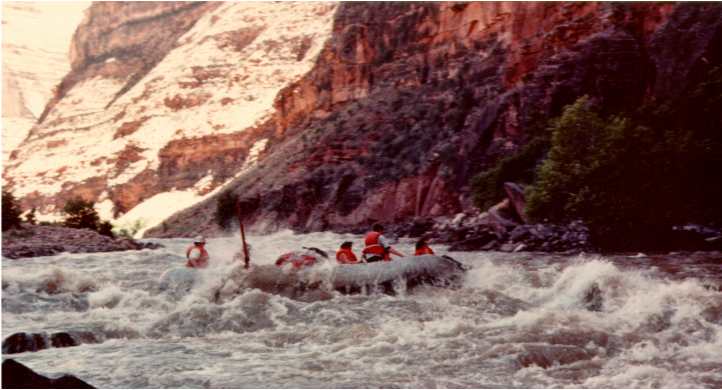
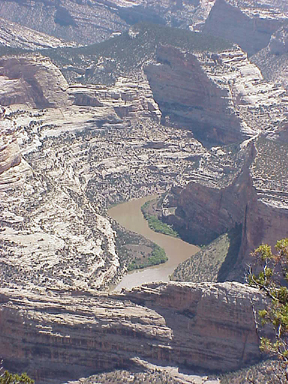
River Rats (above) Steamboat Rock, at the Confluence of the Green and Yampa Rivers (right) |
 |
Number of Visitors
since Oct. 8, 2000:
